

Satellite is now, not the future: LoRaWAN metering for every utility, everywhere
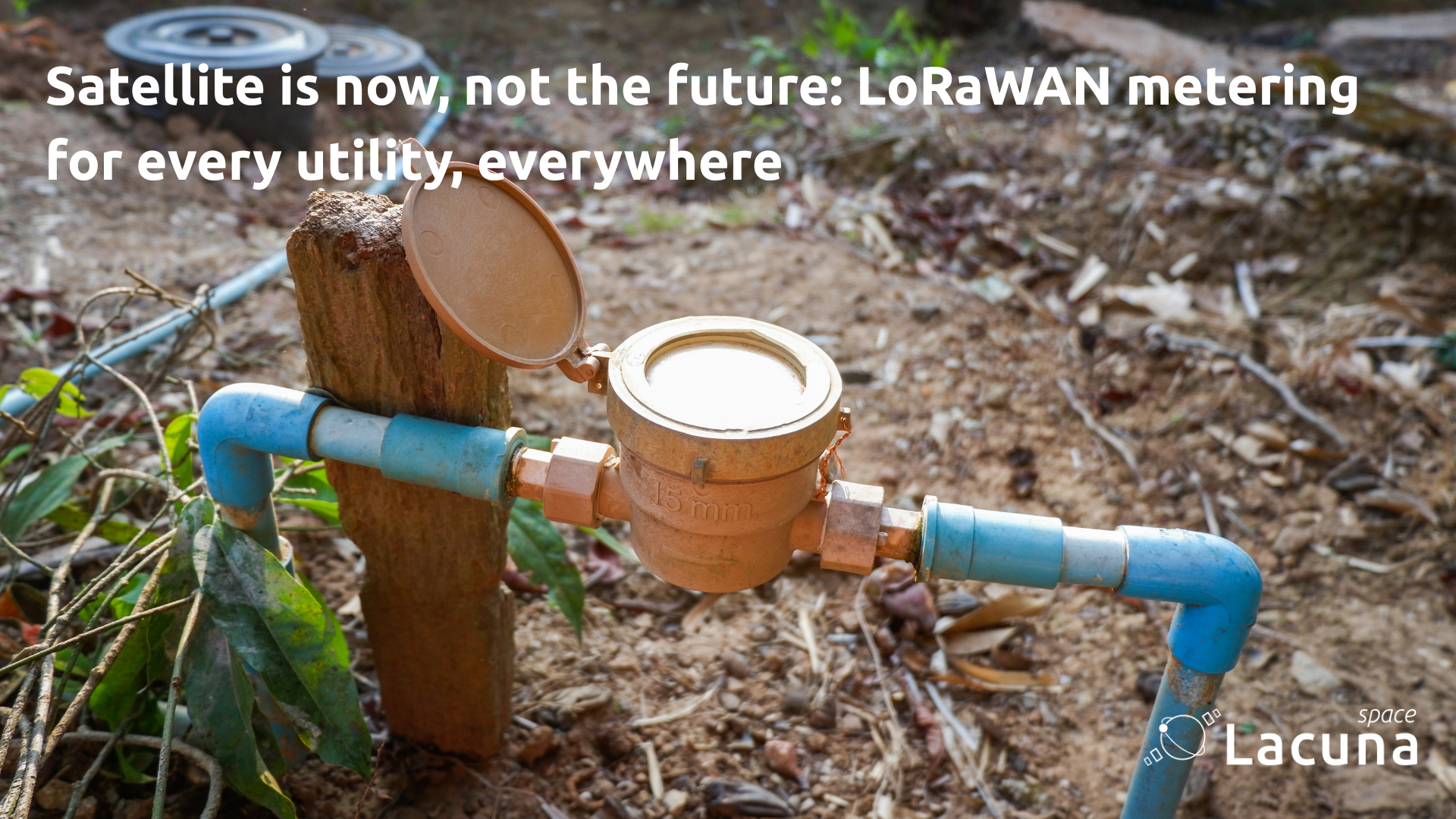
Every utility wants a network that reaches every meter, lasts as long as the meter and costs less to run. Satellite LoRaWAN now delivers all three, anywhere in the world. ZENNER’s satellite meter interface unit, built on Lacuna Space’s direct-to- device satellite IoT network, is heading into production, using the same radios and the same open standard the metering industry already relies on.
One network, worldwide
Smart water metering is growing fast. Berg Insight expects water utility AMI endpoints in Europe and North America alone to nearly double, from 79.1 million in 2025 to 154.5 million by 2031, and utilities on every continent are making the same move. Each of them has to answer the same question first: how will the data get home?
The usual answers all carry a cost. Private networks need gateways planned, installed, powered and maintained for the life of the meters. Cellular depends on operator coverage and contracts, and on network generations that change far faster than the life of a meter, as utilities that relied on 2G and 3G have learned. And terrestrial networks rarely reach every meter. Frost & Sullivan warns that “AMI networks may not provide continuous coverage in difficult terrain”, while water industry adviser Adam Tank of HydroKnowledge observes that projected read rates of 95% or more often fall to 87–91% once meters go live.
Satellite answers the question once, for everywhere. Lacuna Space, based in the UK and the Netherlands, operates low Earth orbit satellites that receive messages directly from LoRa-based devices on the ground, with worldwide coverage. That makes remote meter reading possible wherever a utility operates: in a growing city, on a coastal island or in a mountain valley, with no gateways to install, no backhaul to manage and no network to build before the first meter goes live. As Rich Sanders, President of ZENNER USA, put it at ACE 2026, satellite “can reach every place on the planet. Doesn’t matter if it’s an ocean, doesn’t matter if it’s a desert.”
LoRaWAN makes it possible
What makes this remarkable is how little changes at the meter. Lacuna’s LoneWhisper®® network uses the same LoRa radios and the same transmit power as terrestrial LoRaWAN, with LR-FHSS, a low-power satellite adaptation of LoRa that is compatible with LoRaWAN sensors. A battery-powered unit in a pit at ground level reaches a satellite 1,000 km away and can run on a single battery for years.
For meter makers, satellite is an extension of what they already build, not a new product line. The same open supply chain of LoRa components applies, and Lacuna’s LWiN®® device software, which manufacturers can license for their own designs, handles the timing, frequency and power of each transmission. A single device can use a terrestrial LoRaWAN network where one exists and satellite everywhere else, and Lacuna can also act as satellite backhaul for existing LoRaWAN smart meters where connectivity is weak. Utilities choose the mix that suits them: satellite as their primary network, or alongside the LoRaWAN infrastructure they already own.
How satellite meter reading works
Each meter sends a small message, typically under 30 bytes, such as a meter reading, to a passing Lacuna satellite. The satellites broadcast their pass times, so devices wake only when one is overhead, which keeps battery use low. Lacuna’s KonflexHub®® platform receives the data from orbit, stores it securely in the cloud and delivers it, with end-to-end encryption, to a standard LoRaWAN network server or straight into the utility’s own systems. The platform is GDPR-ready for European utilities.
The network is built for small, slow-changing data rather than live control: readings typically arrive once or twice a day, which suits billing, consumption profiles and leak alerts. Lacuna is now flying its fifth generation of satellite payloads, and its satellites have mapped radio-frequency use and noise levels worldwide since 2020 to avoid interference. The technology is the result of nearly ten years of research and development and more than €20 million of investment, co-funded by the UK Space Agency, the European Space Agency and private investors.
Lower cost, no obsolescence, ready for disasters
Rich’s case applies to every utility, wherever it operates. On cost, he said satellite comes in at a fraction of what cellular charges, with a far simpler path for the data. On infrastructure, “there’s no need for terrestrial infrastructure… which is a blessing for the utilities, because the utilities have to maintain that.”
On longevity, satellite avoids the obsolescence that comes with cellular network switch-offs: the network is upgraded in orbit, generation by generation, while meters on the ground keep working. And on resilience, “with satellite, you’re immune to disaster areas where it takes your infrastructure down.” When storms, floods or wildfires take out local power and towers, readings and leak alerts keep arriving when utilities need them most.
Proven by an industry leader
The first metering company to take this path is one of the most experienced. The Minol-ZENNER Group runs what the LoRa Alliance calls the world’s largest LoRaWAN network, with 11 million sensors active as of May 2026.
In June, at ACE 2026 in Washington, D.C., ZENNER USA unveiled its satellite meter interface unit (MIU), developed with Lacuna, Semtech and Kyocera. The satellite antenna is integrated into the MIU, which installs in the pit lid at ground level like any other unit, and the same device works with terrestrial networks too.
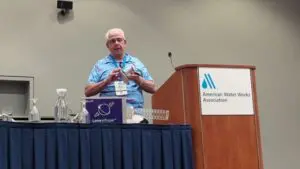
Rich Sanders, President of ZENNER USA, presents the satellite MIU at ACE 2026.
ZENNER has selected Lacuna to scale up its satellite service, with trials through 2026 and scale-up volumes planned for 2027. And it scales to any size of utility: “Whether it’s one device or a thousand or a hundred thousand devices, you can do it with satellite.” Rich’s advice to the rest of the industry: “If you’re developing a product and you want it to go over satellite, I suggest you talk to Lacuna.”
More than meter reading
When every meter can be read, utilities can do more with the data. Tackling non-revenue water depends on a complete water balance: comparing what each district meter supplies with what every customer meter records. A single unread meter breaks that balance. With every meter connected, utilities can measure losses district by district, find leaks sooner and send crews where they are needed.
The same satellite link serves gas meters, leak and pressure sensors, flow monitoring, tank levels and wells, from the treatment works to the furthest customer. One open technology and one supply chain can cover every asset under the sky.
Built on an open standard
Satellite metering only scales if it stays open. As Rich told the ACE audience, “Open standards are where the world will go.” Utilities have learned the cost of proprietary networks that lock them into a single vendor. LoRaWAN, developed and promoted by the LoRa Alliance, gives them a choice of interoperable meters, networks and suppliers.
Lacuna is committed to keeping satellite LoRaWAN just as open. The LoRa Alliance has recognised Lacuna as the driving force behind extending LoRaWAN beyond terrestrial networks, and within the Alliance, Lacuna leads the LoRaWAN over Satellites Task Force, which is working to standardise the interoperability of satellite modes. The goal is simple: LoRaWAN devices that work across terrestrial and satellite networks, whichever operator runs them.
The opportunity for meter makers
Satellite metering is no longer a concept on a roadmap. It’s real hardware from a market leader, heading into mass production with an established partner ecosystem behind it. The manufacturers who move early will shape what utilities around the world come to expect next.
Lacuna is proud to work with ZENNER, and our network is open to every metering company. Whether you make meters, MIUs or communication modules, you can add satellite to the LoRaWAN products you already build, using the components you already buy. Start with a pilot, then scale to thousands of connected meters without changing your network set-up.
See it at Enlit Europe in Vienna, 10 to 12 November 2026. The Lacuna Space team will be available with the LoRa Alliance on its Pavilion (stand B.f120), where ZENNER’s satellite MIU will be on display in our showcase. Come and talk to our team about bringing satellite coverage to your meters, or get in touch to book a meeting.
Frequently asked questions
Does satellite metering work for meters in pits?
Yes. ZENNER’s satellite MIU installs in the pit lid at ground level, with the satellite antenna integrated into the unit.
Can one device use both terrestrial LoRaWAN and satellite?
Yes. The same device can use a terrestrial LoRaWAN network where one exists and satellite everywhere else.
How often do readings arrive?
Lacuna’s network is designed for small, slow-changing data. Readings typically arrive once or twice a day, which suits billing and consumption monitoring.
Where does the data go?
Lacuna’s KonflexHub®® platform delivers it, with end-to-end encryption, to a standard LoRaWAN network server or directly into the utility’s own systems.
Want to read more? Have a look at how we approach remote grain monitoring, or explore our solutions.
About Lacuna Space
Lacuna Space delivers direct-to-device IoT connectivity service using ultra-low-power protocols optimised for small, infrequent messages. Built on its proprietary LoneWhisper® technology, Lacuna Space’s network supports remote sensors across agriculture, environment, utilities, and the oceans — enabling reliable global coverage with no ground infrastructure.
Lacuna Space operates from offices in the UK and the Netherlands, with support from the UK Space Agency and the European Space Agency.