

Closing the Data Gap: Reliable Soil Moisture Monitoring from Orbit
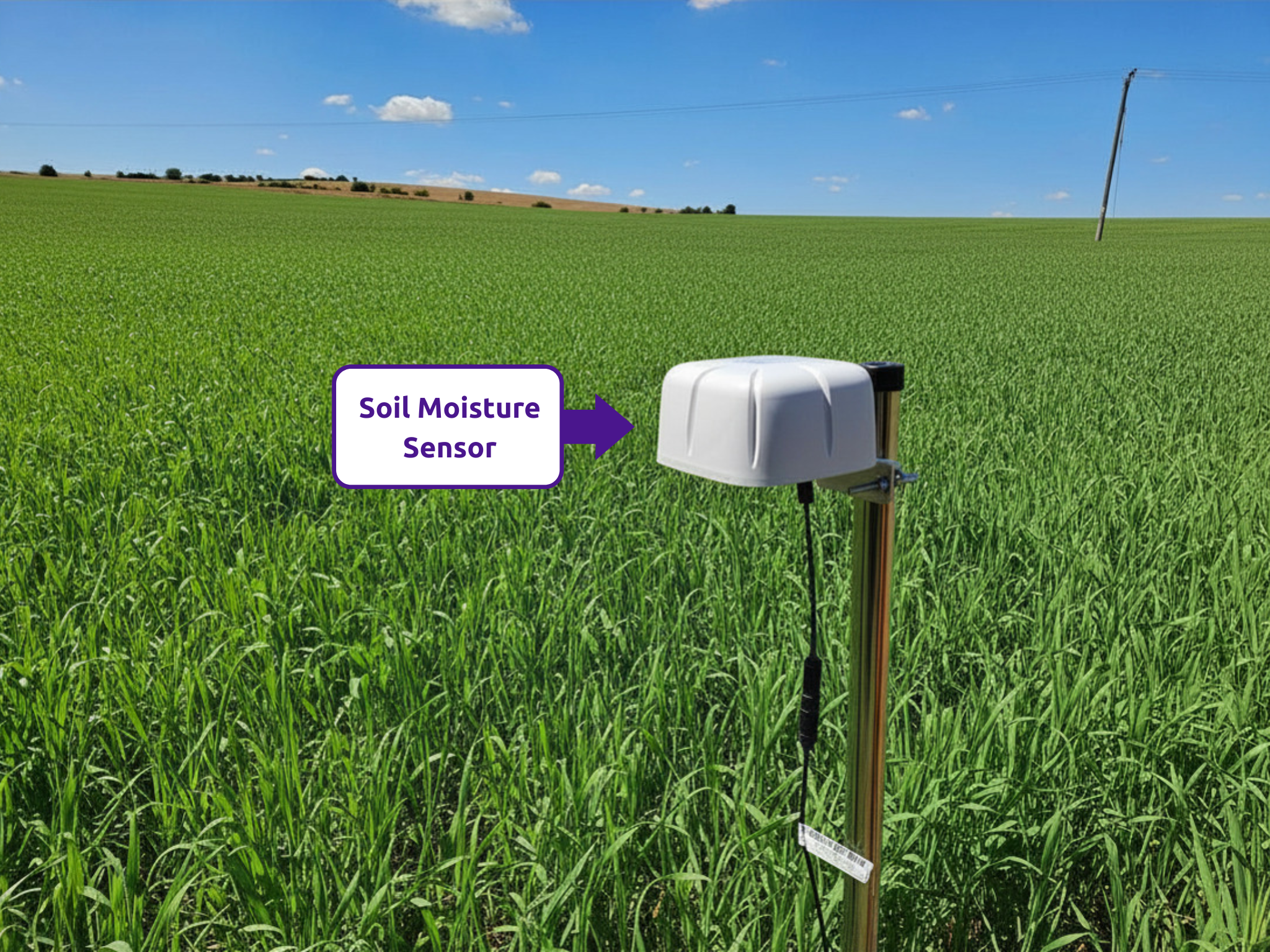
By bypassing the physical limits of terrestrial gateways, Lacuna Space provides a direct-to-orbit link that turns fragmented soil moisture readings into a persistent baseline for global crop resilience.
The global agricultural sector currently accounts for approximately 70% of all freshwater withdrawals World Bank, 2024. Yet, as we push toward a 2050 mandate to feed 10 billion people, our primary method of managing this finite resource remains startlingly imprecise. In the high-stakes world of commercial seed production and global crop R&D, where giants like Bayer and Syngenta spend over a decade and $100 million to bring a single variety to market and the lack of continuous soil moisture data isn’t just an inefficiency; it’s a multi-million dollar structural risk.
We are currently living through a “Connectivity Paradox.” While the sensors themselves have reached near-scientific perfection, the infrastructure used to transport their data has failed to keep pace. Nearly 80% of the Earth’s surface lacks the terrestrial cellular or LPWAN coverage required to support “Digital Farming.” When a field trial in a remote region goes “dark,” the data integrity of the entire season is compromised. You cannot retroactively measure the moisture profile of a heatwave that occurred while your gateway was offline.
The Science of Soil Moisture Monitoring
To understand why connectivity is the final frontier, we must look at the measurement itself. In a professional research context, soil moisture is a complex physical state. We are measuring Volumetric Water Content (VWC) and Soil Water Tension across a vertical column to understand infiltration. This is the process of water moving through the soil and becoming available to the root system.
Modern probes use two primary methods to capture this ground truth –
- Frequency Domain Reflectometry (FDR) sensors from leaders like Sentek and DFM Technologies use the soil dielectric constant to calculate water content. Since water has a dielectric constant of 80 compared to only 3 or 5 for dry soil, the precision is extremely high.
- Time Domain Reflectometry (TDR) is the research gold standard used by Delta-T Devices. It measures the travel time of an electromagnetic pulse and is less sensitive to soil salinity. This makes it essential for high-accuracy trials (FAO Water Management).
The Terrestrial Connectivity Problem
For years, the AgTech industry tried to force terrestrial solutions like 4G or local LoRaWAN gateways into deep-field environments. This architecture relies on proximity, which creates network black holes.
If you are relying on terrestrial gateways, you are accepting three inherent failure points:
- Topographical Shadowing: Radio signals at the sub-GHz level are easily blocked by hills, dense forest, or even the growth of the crop canopy itself. In a remote trial, a sensor just three kilometers away from a gateway can effectively “disappear.”
- Infrastructure Maintenance: Gateways require solar power, mounting poles, and backhaul links (like a 4G SIM). In remote regions, solar panels get covered in dust, batteries fail in the heat, and roaming agreements between telcos are notoriously brittle.
- The Operational Sinkhole: For an Innovation Lead managing trials across twenty different countries, managing twenty different local connectivity setups is a logistical nightmare. The cost of “keeping the lights on” often exceeds the cost of the actual R&D.
The Satellite Solution
Lacuna Space changes the math by moving the gateway from the ground to a constellation of Low Earth Orbit (LEO) satellites. We have turned the entire planet into a single, uniform coverage zone. The mechanism is simple. The soil moisture sensor is equipped with a Lacuna-enabled node that transmits data directly to the satellite as it passes overhead. There is no local gateway, no SIM card, and no edge to the network.
This shift to Satellite- Direct LoRaWAN® provides three critical benefits to Big Ag:
- Universal Uniformity: A trial site in the Nebraska Sandhills is managed exactly like a site in the Brazilian Mato Grosso. The hardware is the same, the data format is the same, and the reliability is the same.
- Battery Longevity: Because LoRa is an extremely high-sensitivity protocol, the sensor can reach a satellite 500km away with the same power consumption it would use to reach a terrestrial gateway 5km away. This enables “set-and-forget” deployments that last for five years or more.
- Total Data Integrity: Because there are no local “middle-men” (gateways), the chance of data packet loss is significantly reduced. The data moves from the soil to the satellite to the cloud in a single, secure hop.
De-Risking the Future of Food through Data Continuity
High-fidelity data is the foundation of autonomous agronomy. Predictive models and yield-forecasting platforms require uninterrupted datasets to identify the next generation of climate-resilient seeds. When connectivity fails, researchers must use mathematical interpolation to fill the gaps. This is essentially guesswork that fails to capture sudden environmental shifts and significantly lowers the statistical confidence of the entire breeding selection.
Lacuna Space eliminates this uncertainty by providing a consistent satellite-direct data stream that preserves the ground truth in its raw state. This de-risks the 100 million dollar breeding funnel by allowing researchers to move from estimation to certainty when comparing variety performance. By supporting hardware from Sentek and Delta-T Devices, we provide a global voice for the sensors that Growers already trust. We are ensuring that every genetic trait is understood regardless of how remote the field trial is. The technology to measure the Earth is already in the ground. It is time we used the infrastructure in the sky to listen to it.
Lacuna Space is here to help you scale.
About Lacuna Space
Lacuna Space delivers direct-to-device IoT connectivity service using ultra-low-power protocols optimised for small, infrequent messages. Built on its proprietary LoneWhisper® technology, Lacuna Space’s network supports remote sensors across agriculture, environment, utilities, and the oceans — enabling reliable global coverage with no ground infrastructure.
Lacuna Space operates from offices in the UK and the Netherlands, with support from the UK Space Agency and the European Space Agency.