

Why You Can’t Save Germany’s Peatlands with Traditional Cell Towers
Bridging the data gap in Germany’s remote landscapes with satellite-powered remote IoT connectivity for precision peatland restoration and verifiable ESG reporting.
Germany is globally recognised as a powerhouse of industrial automation. The nation’s Industry 4.0 initiatives lead the world in factory efficiency, supply chain transparency, and urban smart grids. Yet, step outside the automated factory gates and enter the rugged terrain of the Harz Mountains or the dense canopies of the Black Forest, and the digital thread snaps.
The Bundesnetzagentur (BNetzA) report frequently highlights that corporate network coverage across Germany reaches nearly 98%. However, this statistic masks a stark geographical reality. According to data by Bitkom and the DLG, 51% of German farmers and land managers cannot deploy digital tools because their specific hectares sit in absolute dead zones also known locally as a Funkloch.
While terrestrial cellular networks serve urban centers well, the infrastructure protecting Germany’s natural resources has hit a physical wall. Topography, steep valleys, and dense forestry create signal shadows that terrestrial masts cannot penetrate. For the German Mittelstand, environmental agencies, and ESG compliance officers, this connectivity gap is no longer merely an inconvenience; it is a significant regulatory and economic liability.
At Lacuna Space, we address this modernisation vacuum by shifting the perspective. We do not ask regional authorities to build expensive, ecologically disruptive radio towers in protected nature reserves. Instead, we look up. By creating an infrastructure-free, direct-to-satellite network, we are connecting the unconnectable across Germany’s most challenging environments.
The Peatland Carbon Liability: Quantifying Moorwiedervernässung (Peatland Rewetting)
The regulatory pressure on German enterprises and public bodies intensified significantly when Germany joined the Global Peatlands Initiative as a champion country last year (2025).This binding commitment focuses on the rapid restoration and rewetting of degraded peatlands a localised process known across the federal states as Moorwiedervernässung.
Historically, over 90% of Germany’s 1.8 million hectares of peatlands (Moore) were systematically drained for intensive agriculture and forestry. Today, these dried landscapes act as massive, continuous carbon emitters. Environmental data published by the Federal Environment Agency (UBA) and analysed by Clean Energy Wire reveals that drained peat soils release roughly 53 million tonnes of CO2 equivalents annually. This immense volume single-handedly positions Germany as the largest emitter of greenhouse gases from degraded peatlands within the entire European Union, transforming these natural landscapes into a critical climate liability.
Restoring these complex ecosystems has become a generational task crucial to meeting national net-zero targets. However, executing this strategy at a national scale has revealed a critical operational barrier: a severe deficit of actionable field data.
The Carbon Math vs. The Data Deficit
Under the current Bund-Länder agreements, Germany aims to rewet 250,000 hectares of peat soils by 2030 to curb agricultural emissions. Currently, the nation manages an average of only 2,000 hectares of rewetting per year. Research from the Fraunhofer Institute explicitly attributes this slow progress to a Mangel an Monitoringdaten—a profound lack of high-fidelity, real-time data from the field.
To convert a degraded peatland into an active carbon sink, land managers cannot simply flood the terrain and walk away. Successful restoration depends on precise hydrological management:
- The Oxygenation Threshold: If the water table drops even 10 to 20 centimeters below the surface, oxygen penetrates the organic peat layers. Microbes immediately begin decomposing the ancient plant matter, rapidly converting stored carbon into CO2
gas. - The Methane Flashpoint: Conversely, if the terrain is flooded too deeply, anaerobic decomposition shifts, creating massive spikes of methane , a greenhouse gas with a global warming potential significantly higher than carbon dioxide.
Maintaining this delicate equilibrium requires environmental agencies like the Thünen Institute to monitor the water table to within centimeters of the surface across vast, unpredictable wetlands.
![[Drained Peatland: CO2 Source] Oxygen Entry ---> [ Dry Peat Layer ] ---> Releases 40+ Tonnes CO2/Hectare/Year [Over-Flooded Peatland: Methane Source] Deep Standing Water ---> [ Anaerobic Decomposition ] ---> High Methane (CH4) Spikes](https://lacuna-space.com/wp-content/smush-webp/2026/05/Germany-3-300x92.png.webp)
Optimised Rewetting: Lacuna Monitored – (Water Table at Surface <— [ Ground Sensors Tracking via LEO Satellite ] —> Carbon Neutral / Sink)
The Physical Failure of Terrestrial Networks
Acquiring this continuous sub-surface data presents a severe geographical challenge. A healthy, rewetted Moor (peatland) is a highly corrosive, soggy, and shifting environment entirely devoid of roads, electrical grids, or cellular connectivity.
Traditional terrestrial IoT tracking systems fail in these environments for several distinct reasons:
- Line-of-Sight Limitations: Peatlands often sit in low-lying structural depressions. This topography leaves ground-level sensors sitting far below the radio horizon of distant commercial cellular masts, cutting off communication.
- The Maintenance Crisis: Standard cellular or satellite modems consume high amounts of power. They require heavy industrial batteries paired with large solar panels. In a wetland, solar panels quickly become covered in algae, bird droppings, or dense marsh vegetation, causing system failures within weeks. Sending technicians into unstable wetlands to swap batteries or clean panels is dangerous, expensive, and logistically unviable.
- Infrastructure Intrusiveness: Building permanent ground gateways or running power cables through protected nature reserves violates strict federal conservation laws (Naturschutzgebiete), rendering terrestrial infrastructure legally impossible to deploy.
Without an automated way to collect this data, agencies must rely on manual data collection. Technicians have to trek into the bogs with physical dipsticks to read water gauges. This manual approach yields fragmented data, high operational costs, and fails to provide the continuous validation needed for modern environmental auditing.
The Lacuna Solution: Infrastructure-Free Verification
Lacuna Space addresses this data gap by removing the need for terrestrial infrastructure entirely. Instead of attempting to transmit data horizontally across blocked terrain to a distant cell tower, our architecture transmits vertically. We use low-power ground sensors that communicate directly with our fleet of Low Earth Orbit (LEO) satellites as they pass overhead.
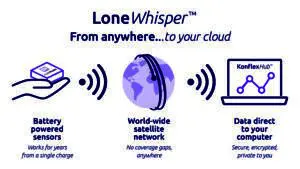 By leveraging open LoRaWAN protocols optimised for space communication, we deliver a technical solution tailored to the realities of German environmental protection:
- Direct-to-Satellite Connectivity: Ground nodes transmit data straight to space, completely bypassing regional topography, vegetation canopies, and local Funklöcher.
- Multi-Year Battery Life: Our biggest competitive advantage is ultra-low energy consumption. Ground sensors utilize our proprietary LoneWhisper® technology, remaining asleep for most of the day. They wake up for only a fraction of a second to transmit data when a satellite is directly overhead. This efficiency allows a single, low-cost commercial battery to power an underground sensor node for up to a decade, entirely eliminating the need for solar panels or field maintenance.
- Audit-Ready Data Pipelines: To unlock private green investment via carbon instruments like MoorFutures, or to satisfy ESG corporate liability audits, data must be continuous and tamper-proof. Lacuna ensures end-to-end AES-128 encryption from the peatland floor to your cloud.
- Low Operational Cost: Without the need to lease land for towers, run fiber-optic backhaul, or supply grid power to remote valleys, the cost per data point drops significantly. This makes large-scale deployments across millions of hectares financially viable for regional authorities and Mittelstand budgets.
Our direct-to-satellite network listens for these faint whispers from the wild, delivering accurate ground truth from the most inaccessible corners of the country. By utilising our infrastructure-free approach, German environmental agencies and corporate landowners can convert climate risks into verifiable carbon assets.
Learn more about how we scale these open frameworks on our Lacuna Technology Page.
About Lacuna Space
Lacuna Space delivers direct-to-device IoT connectivity service using ultra-low-power protocols optimised for small, infrequent messages. Built on its proprietary LoneWhisper® technology, Lacuna Space’s network supports remote sensors across agriculture, environment, utilities, and the oceans — enabling reliable global coverage with no ground infrastructure.
Lacuna Space operates from offices in the UK and the Netherlands, with support from the UK Space Agency and the European Space Agency.