

From Ghana to Brazil – A Satellite Powered Early Warning System for Banana Farms

Turning silent banana estates into intelligent ecosystems by bridging the connectivity gap with battery-powered, direct-to-satellite sensors.
Bananas feed hundreds of millions of people and underpin rural economies across the tropics. Yet the crop lives under constant biological pressure. Black Sigatoka, a fungal disease that attacks banana leaves and reduces photosynthetic capacity, can cut yields by 30 to 50 percent if left unmanaged. Even with fungicide control, growers often still lose 2 to 5 percent of output, while spray frequency continues to rise as resistance builds.
This is not just a plant pathology problem. It is a data problem.
Banalytics, an Innovate UK funded feasibility study, brings together Lacuna Space in the UK, AyaData in Ghana, UNESP and EMBRAPA in Brazil, supported by the UK Agri-Tech Centre, to explore a new model of disease management. The ambition is simple but transformative – to move from labour intensive visual monitoring to a continuously learning, AI driven early warning system powered by satellite connected sensors.
From Under the Canopy to Orbit
The project began in Ghana with a visit to a leading organic commercial banana farm, Golden Exotics. Here, Lacuna Space positioned low-power temperature and humidity sensors beneath the banana canopy. Once fully calibrated and linked, these devices transmit data directly to satellites. Consequently, this removes the dependency on cellular coverage in remote estates.
Why start with microclimate?
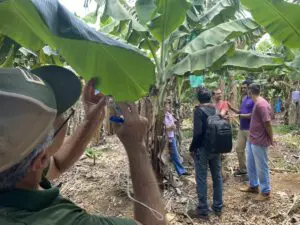
Lacuna Space consultants conversing with UNESP’s phytopathology team in São Paulo state in Brazil
Because disease pressure is not abstract. It emerges from specific combinations of temperature, humidity, leaf wetness, and airflow within the canopy itself. Essentially, if you cannot measure the environment where the fungus lives, you are only guessing.
The Ghana deployment establishes the first layer of what can be described as a digital nervous system. Environmental data flows upward to orbit, then into AyaData’s AI environment, where modelling begins.
The consortium then travelled to São Paulo state in Brazil to work closely with UNESP’s phytopathology team, visiting multiple banana farms as well as EMBRAPA’s AgNest facilities. Brazil offers decades of structured monitoring data, including a weekly Evolution Stage database dating back to 2019. That historical record is gold dust for model training. The visit confirmed both the scientific depth of Brazilian expertise and the urgent demand from growers for something better than manual inspection.
The Limits of Human Monitoring
Today, Black Sigatoka monitoring remains labour intensive and subjective. Agronomists inspect leaves weekly, in a model that samples ten trees per hectare. Early infection stages are subtle. Assessment depends on experience. Spray thresholds are triggered by visual scoring. As disease pressure increases, so too does the frequency of fungicide application.
Spray operators expressed particular concern about thermal inversion. If warm air rises from the ground during application, spray droplets do not settle properly on leaves. As a result, fungicide efficacy drops, inputs are wasted, and resistance pressure increases. Without precise canopy-level temperature gradients, this risk remains invisible.
In other words, the current system is reactive, intermittent, and human-bound. It does not scale easily, nor does it learn continuously. Most importantly, it fails to integrate soil, climate, and imaging in a unified way.
Banalytics asks whether we can change that entire paradigm.
Three Signals That Matter
Early work across Ghana and Brazil identified three critical data domains that could fundamentally improve forecasting.
First is microclimate differentiation above and below the canopy. Measuring temperature and humidity at multiple heights allows detection of thermal inversion and more accurate timing of spray windows. Rather than spraying on a schedule, application can be aligned with atmospheric reality.
Second is soil nutrient intelligence. In many farms, soil sampling is conducted manually and infrequently, sometimes once per year. Yet nutrient balance strongly influences plant resilience and disease susceptibility. Brazilian researchers have spent decades developing nutritional models, but they require dense, continuous data to reach their full potential. A grid of NPK sensors every 50 metres could create a living baseline, feeding both nutrient optimisation models and disease forecasting algorithms.
Third is early spot and lesion detection of Black Sigatoka through AI enabled imaging. UNESP has already developed models based on early manual detection. The feasibility study explores whether low cost, low power cameras connected via satellite could automate early stage detection. The challenge lies in canopy geometry, lighting, spectral selection and power constraints. But if solved, image data becomes another stream into the model, reducing subjectivity and accelerating detection at stages when fungicides are most effective.
Each signal on its own adds value. Together, they begin to resemble something more powerful.
The Corporate Brain for the Farm
Large language models have shown what happens when vast volumes of data are structured and trained into a coherent system. The same principle applies in agriculture. IoT is the fuel. AI is the engine.
A banana estate produces environmental data, soil data, phenological signals and disease indicators every day. Historically, this information has been complex to generate, manage and interpret. With satellite connected sensing, it becomes persistent, structured and analysable.
Imagine a system where:
- Microclimate forecasts predict disease progression 7, 11 or 15 days ahead.
- Soil nutrient variability is mapped continuously rather than annually.
- Image classifiers detect early lesions without waiting for weekly visits.
- Spray timing is aligned with canopy physics rather than calendar intervals.
This is not simply disease monitoring. It is the emergence of a corporate brain for the farm. A private AI model trained on that farm’s own environmental history, biological pressure and nutrient behaviour. A system that improves with each season.
The Brazil visit confirmed the building blocks. UNESP provides deep phytopathological expertise and historical disease datasets. EMBRAPA’s AgNest facilities offer structured environments for field validation under Brazilian production conditions. Aya Data brings AI model development and classifier validation capability across Ghana and Brazil. Lacuna Space provides the connectivity layer that makes remote, under canopy sensing possible even where there is no mobile signal.
Only 40–50% of Brazil’s landmass has mobile data coverage (3G/4G/5G), aggregated across all operators.
The feasibility study now focuses on calibrating in field sensors against weather station data, testing forecasting lead times, assessing integration of additional biological and nutritional variables, and validating models across continents. Ghana deployments will generate local data for tropical validation. Brazilian datasets provide historical grounding. Together, they create a cross continental learning loop.
Towards Predictive, Sustainable Control
The market signal is strong. Growers want reliable, low cost devices that reduce labour and subjectivity. Spray operators want confidence that applications are optimally timed. The production chain needs lower input costs and stronger sustainability credentials.
By catching outbreaks earlier and aligning sprays more precisely with environmental conditions, fungicide use can be reduced and better targeted. Yield loss can be minimised. Resistance pressure can be slowed. Data becomes the tool for sustainability rather than an administrative burden.
Black Sigatoka will not disappear. But its management can become smarter.
Banalytics is still a feasibility study. Yet it points toward a future in which remote banana estates are no longer data blind. Satellite IoT turns isolated farms into connected systems. AI transforms sensor streams into agronomic foresight. And banana production begins to operate not on weekly inspection cycles, but on continuous learning.
The banana farm stops reacting.
It starts thinking.
About Lacuna Space
Lacuna Space delivers direct-to-device IoT connectivity service using ultra-low-power protocols optimised for small, infrequent messages. Built on its proprietary LoneWhisper® technology, Lacuna Space’s network supports remote sensors across agriculture, environment, utilities, and the oceans — enabling reliable global coverage with no ground infrastructure.
Lacuna Space operates from offices in the UK and the Netherlands, with support from the UK Space Agency and the European Space Agency.