

How Satellite IoT Solves Utility Metering Gaps in France
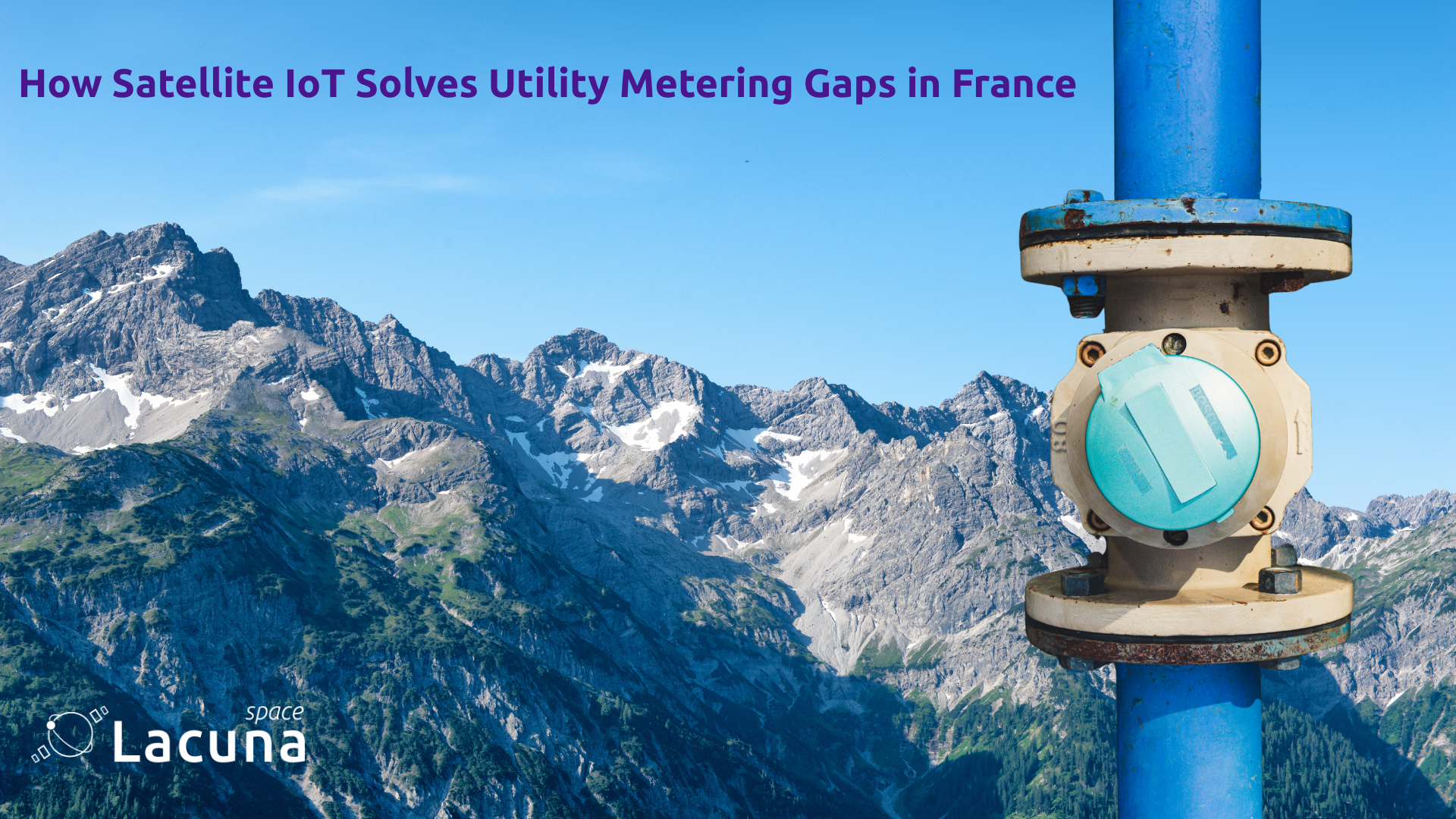
When the terrain makes traditional network backhaul impossible, direct-to-device satellite IoT ensures France’s most remote utility assets never run in the dark.
France didn’t wait around for utility digitalisation. Through its subsidiary Birdz, Veolia has connected over three million water meters to Orange’s LoRaWAN network, enabling remote reading across more than 30,000 municipalities and reaching 95% of the population of metropolitan France. By most measures, France’s water and energy networks are among the most connected in Europe.
But “95% of the population” is not the same as “95% of the territory.” The remaining slice of population is spread thin across exactly the terrain that’s hardest to operate in: Alpine and Pyrenean valleys, scattered rural communes, and the long, thin pipeline and grid networks built to serve them. That gap isn’t theoretical and it shows up directly in the performance numbers utilities are measured against.
The Real Cost of the Last Stretch
National water-network efficiency in France averages around 80%, but in mountainous départements like the Hautes-Alpes and Alpes-de-Haute-Provence, yields drop to 60–70%. Among small rural communes with fewer than 1,000 residents, average leak rates sit near 50%, well above the legal ceiling of 35%. The reasons are structural rather than a question of effort: rural networks run far more kilometres of pipe per subscriber, through terrain that makes inspection slow, costly, and infrequent. These are exactly the places where continuous, remote monitoring would change the economics the most and exactly the places where it has historically been hardest to install.
The same logic applies beyond water. A rural substation or a remote section of a gas pipeline doesn’t generate less risk just because fewer people live nearby; if anything, the isolation makes a fault harder to detect and slower to fix.
Why “No Coverage” Usually Means “No Backhaul”
It’s worth being precise about what actually breaks down in these areas, because it’s rarely the radio link people assume. Sub-GHz LoRa signals travel remarkably far over open terrain — gateways can often hear sensors many kilometres away, even across valleys. The real constraint sits one step further along the chain: every LoRaWAN gateway still needs its own backhaul connection that is fibre, ethernet, or cellular to get that data to the network server at all. In the mountain valleys and remote rural stretches where these assets sit, none of those options reliably exist: no fibre was ever run, there’s no fixed line to tap into, and mobile networks don’t reach. The gateway has nowhere to send what it hears, no matter how clearly it hears it.
That leaves these sites without a workable terrestrial option at all. A gateway can’t be backhauled over a connection that doesn’t exist, so utilities are left choosing between an extreme, often impractical infrastructure build, running power and a fixed line into terrain that may not support either or leaving that part of the network unmonitored. In practice, it’s almost always the latter. Not from a lack of will, but because there’s simply no cost-effective way to get the gateway itself online.
Removing the Backhaul Problem Entirely
This is the specific gap direct-to-device satellite IoT is built to close. Lacuna Space’s network works with LoRaWAN-compatible devices already familiar to French utilities, but instead of routing data through a local gateway and its backhaul, devices transmit straight to satellite, delivering data at least once a day from wherever they’re sited. There’s no gateway to install, power, or connect which means there’s no backhaul problem to solve on a dam access road, along a Pyrenean pipeline route, or at a substation tucked into an Alpine valley.
For water companies, grid operators and LoRaWAN network operators who have already invested heavily in terrestrial infrastructure to cover 95% of the population, Lacuna isn’t proposing a replacement. It’s built to pick up precisely where that gateway network reaches its practical and economic limit.
Built for Sites Nobody Wants to Visit Twice a Year
Remote pipeline pressure sensors, substation monitors, and pumping-station alarms in these regions share one requirement above all: whoever installs them shouldn’t need to come back for years. Devices on Lacuna’s network are designed to run for years on standard, off-the-shelf batteries, no solar panel, no mains power and no scheduled maintenance visit just to keep them transmitting. For assets where a single site visit can mean a half-day round trip into the mountains, that difference changes the maintenance budget as much as the data itself.
Lacuna Space’s network is open and commercially available at national scale across France today. Whether the need is monitoring rural water infrastructure that’s already losing more than it should, extending an existing LoRaWAN deployment past its current gateway footprint, or covering grid assets that sit outside any practical backhaul range, the technology is ready to deploy now.
Let’s Talk at ACE
If your organisation manages infrastructure that sits beyond where terrestrial backhaul makes sense, come find us at ACE ZENNER booth 1607. We’ll show you exactly how satellite IoT extends your existing LoRaWAN investment into the territory it was never economical to reach from the city limits to the mountain pass.
Lacuna Space provides direct-to-device satellite IoT connectivity, helping utility providers and network operators reach critical infrastructure wherever it’s located — no gateways to install, no backhaul to solve.
Ready to connect your next environmental project? Whether you’re looking into smart water metering or remote soil moisture sensing, Lacuna Space is here to help you scale.
About Lacuna Space
Lacuna Space delivers direct-to-device IoT connectivity service using ultra-low-power protocols optimised for small, infrequent messages. Built on its proprietary LoneWhisper® technology, Lacuna Space’s network supports remote sensors across agriculture, environment, utilities, and the oceans — enabling reliable global coverage with no ground infrastructure.
Lacuna Space operates from offices in the UK and the Netherlands, with support from the UK Space Agency and the European Space Agency.